Pages

Sunday, September 4, 2011

The Natal Period, part 1: Dundee

The tail ends of my South African excursion were defined by two very different towns in two very different provinces.  Very intentionally, I started the trip in Cape Town, in the Western Cape province.  As the dedicated reader knows, Cape Town is a world-class city situated at the base of a stunning and historic peninsula, and bound by two oceans.  What a great place to start!  It also helped that my friend Saranne lives there, and was willing to be my host and tour guide and travel buddy for a period of more than two weeks.  My readers have seen and heard much from the Western Cape province, from Cape Town and the Cape Peninsula, up to the West Coast, and inland to ostriches and semi-desert farms.

The departure from the Western Cape province saw me floundering a bit for some sort of plan (a process which in itself was part of a larger plan--so fret not :).  The trajectory from Cape Town was more or less prescribed:  just go the coastal route, with the occasional inland jaunt.  But it wasn't until my first trip to Durban that I really hit my traveling stride.  Durban, one of the 3 biggest (and most unique) cities in the country, was also the gateway to another large and important province:  Kwa-Zulu Natal. 

My time in "K-Zed-N" was my chance to feel like a true SA native.  The province itself did seem to have it all--lots of rural, traditional, and historic places; a major, bustling coastal city; and incredible natural sites stretching from the Drakensberg mountain range to miles and miles of wetlands, coastal forests, and beach.  But apart from the touristic draws, the province presented opportunities that helped make South Africa feel like home for the first time.  And it was the time spent in someone's actual home which helped kick-start my travel independence.  This post is the story of a little place with a big heart called Dundee.  Let's start with how I got there.

 I was scheduled to visit and stay with my Cape Town friend's family in Dundee.  My trip to Durban before this ended up being the last time I took any sort of proper passenger bus in Africa.  No, who needs Greyhound when you've got the milkman to deliver you?  And that's basically what happened.  My awesome Durban CouchSurfing host Stephen dropped me off at the Durban depot of Orange Grove Dairy.  I left on this truck at about midnight...


...and ended up at the dairy itself six hours later.


The owners of Orange Grove operation were Dave and Sue Durham (parents of my friend Saranne).  I would very soon discover (and continue to be reminded) that they were the busiest pair in all of Dundee--and perhaps KZedN, and maybe all of South Africa!  They were also some of the most generous.  I was encouraged--nay, instructed--to make myself at home in every way.  So I took a bath... or 3.  I had a lot of tea with my rusks.  I (eventually) toured the dairy plant and farm.  And I was taken in, if not wholeheartedly then whole-mouthedly, by these beasts:


Sadly, I don't have many great pictures of the Durham estate.  In the one above with the dogs, you can see the general look of their front yard.  The house itself was large and designed and decorated in a classic mold.  All the rooms had high ceilings, and the furniture and fixtures were simple but handsome.  Behind the house, things were all business:  a large gate and guarded entrance allowed employees, deliveries and visitors into a veritable industrial courtyard.  There was a garage with space and implements to house and repair work and delivery trucks; an L-shaped row of connected brick office buildings; and the dairy bottling plant where all the (post-milking) magic happened.  On my tour I was given a guest pass and a shower cap, and shown the fresh milk storage vats, yogurt making and mixing machines, milk and juice bottling assembly lines, and the place where many of their own bottles are made on site.  It was quite an operation--and that doesn't even include the actual dairy farm, which was across the street and impressive (and educational) in its own right.

I was aware that I would find hospitable accommodations here, but could not predict that Dundee and the Durham farm were to serve as home base for the rest of my time in SA.  It was the Durhams' insistent generosity that put me behind the wheel of a rickety but functional little truck.  This opportunity was the biggest game-changer when it came to getting around without reliance on the bus system.  There will be more on me and my "backkie"--pronounced more like "bucky"--in the next few posts.  And it was their connections with a local tour guide--and pride in their local history--that put me into the hands of some teachers who I would end up seeing again in my final month in the country.

The next several posts will cover my excursions around Kwa-Zulu Natal, from the mountains to the city and sea, and even into a couple more countries that share borders with the province.  It constitutes some of my most free, wild, engaging and rewarding experiences from the entire trip, and I can't wait to share them.  Stay tuned!

A dark but semi-decent view of the big sky of Dundee.  Much of SA reminded me of central and western US, and the combination of pastures, mountains, and towns evoked what I imagine the foothills of the Rockies to be like.


Monday, May 23, 2011

The Terrific Beasts of Africa (part 2)

When it comes time to crafting the perfect African safari, just remember:  don't bother.  (Unless you have lots of money.)  Maybe a better way to explain it is that a good safari experience starts with a good state of mind.  The expectation is just as important as the actual expedition.  Choose small private or large public park; pay money or drive yourself; be the early bird or take an afternoon off:  it all comes down to trade-offs between number of sightings, price, and authenticity.

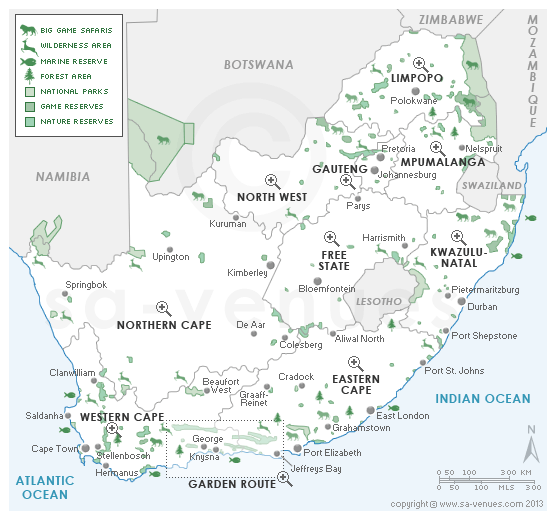
In South Africa there are a host of game parks and reserves, both public and privately owned.  They exist from the Mediterranean and semi-desert lands of the Western Cape to the sandy coastal forests of Kwa-Zulu Natal.  The gem in the crown of South African parks is Kruger National Park.  Kruger lies in the far north-east corner of SA, but has an extensive border along Mozambique, and a smaller one with Zimbabwe.

http://www.sa-venues.com/game_lodges_nationwide_south_afr.htm
I did not go to Kruger National Park.  It was always the plan, and I was excited at the prospect of wrapping up my time in southern Africa with a trip there.  However, it just didn't work out that way.  At the same time, I managed to have two experiences that filled the safari void--in fact, they were each a safari of a sort.
http://www.zululand-accommodation.co.za/img/kzn_zm.gif
Zululand and the Elephant Coast, Kwa-Zulu Natal Province (http://www.zululand-accommodation.co.za/img/kzn_zm.gif)
 My two safaris took place in the Kwa-Zulu Natal Province, more specifically, the so-called "Elephant Coast."  I might call the first one an unintended expedition.  It happened from the open bed of a truck headed to a beach in a St. Lucia park, officially known as iSimangaliso Wetland Park.  It was overcast with a slight drizzle, and me and two friends were zooming through the park in the back with only some coolers to hang on to.  In the cab sat two SA dudes we had just met the night before.  It wasn't until the driver pointed out the zebras to the left that I realized, hey!  I'm on my first safari!  And thus an expectation was set, and an expedition born.

A typical park entrance, except for the nonchalance regarding open containers

Taryn embracing the wind; our host for the weekend getting involved

Maria finds something funny.  This is the closest I got to a shot of any wildlife in these surroundings.

The St. Lucia (public) beach.  The whole park is a World Heritage Site but this part was a bit more local.
Despite the lack of evidence above, we did spot zebra, buffalo, and many "bok" or deer species--all from the cold comfort of standing, in the rain, with a beer, in the back of a boer's truck.  And then there was the view during Sunday brunch.


      *                          *                         *


Our next safari was planned, but not facilitated by anyone except the friend (Taryn) who supplied her 4x4 and myself and another friend (Maria) who made the lunches.  This expedition took place in a placed called Tembe Elephant Reserve, apparently home to a huge and well-maintained elephant herd, along with the rest of the "big 5":  rhinoceros, lion, leopard, and buffalo.  By the time I went here, I was already debating whether or not to go to Kruger.  At Tembe, I would have the chance to see the same animals.  It was also only about 45 minutes away, and FREE.

Again, a safari is part expectation, and usually you want to err on the side of keeping expectations low.  The funny thing about charismatic megafauna is that they basically do what they want, when they want.  Hence, I was prepared to have scenic ride through coastal bush, but not necessarily see a thing.

Below are the pictures of the beasts I DID see.  I must add that there is nothing quite like seeing an elephant herd lumber a half-mile towards your car--and this is something that can't really be captured on camera.

important navigation tasks

Taryn, the Cape-Tonian driver

Reed buck

termite mound

they came our way from the forest


nyala with cud

!  Feed on Sighting !

More nyala.  Their coats apparently change very much as they mature.

the view from the hide
I think he/she saw us first

the mighty dung beetle--a lot of work to doo at the Tembe Elephant Reserve
I truly would have loved to see a lion, and a rhino.  A leopard would have been unbelievable.  It would also be really cool to see a Tyrannosaurus.  But just like in Jurassic Park, even the slow creeping drive through the park without seeing a thing can raise your interest in what could be out there.  It's just the chance of seeing these beasts--as long as you don't actually expect to see them--that made this safari trek worth taking. 

Friday, May 13, 2011

The Seanic Routes, Take 3

It's been quite a while since I commented on my scenic sea route along the southern African coastline.  The wait is now officially over!

The beaches and waters of South Africa--from areas of the western cape up to Durban--are a rich composite of dramatic waves and rocks, along with abundant local and transient sea life.  In the eastern cape, especially, much of it borders rural pastures where cows, goats and sheep roam.  Throughout this stretch, tourists and South Africans with means flock to enjoy any combination of activities.  The pictures below capture the range of reasons to check out this huge stretch of shoreline.

historical fishing implements in a museum in Hermanus

in the distance, a jetty at a Hermanus seaport.  What's that gross blob in the foreground?  I found a rotting whale skull!
Jeffrey's Bay under a full moon.  The big famous surf waves were just to the left

a mate in Jeffrey's bay in the middle of some pristine dunes

ah, Coffee Bay.  perhaps the most outright beautiful and peaceful place in South Africa

lots of shoreline on a hike to the Hole in the Wall.  Note the livestock and dude who thought he was guiding us.

what cow?

here's the guy again.  He sort of "forward stalked" us so he could later claim he was our guide. sorry fella

careful!

interesting coastal geological feature--the Hole in the Wall

I (and the random Pretoria couple) made it!

The actual "Coffee Bay."  I learned to surf here, was called out of the water because of a shark sighting


Durban barge being towed by a helicopter

Durban

there was more surfing in Durban.  This is my friend Kate getting up for the first time

a better picture of the whale skull

Sunday, April 10, 2011

In a Hostel Nation, You Want to Stay at a Nice Backpackers...

Hotels, scientists agree, are a waste of money and often hazardous to your health (citation forthcoming).  They are also just not very fun!  When traveling for pleasure, who wants to be confined to a darkened, soul-sucking chamber with little home comfort and less personality?  Well, I suppose johns, criminals, and anti-social types might.  But the rest of us might be looking for something a bit more authentic when we are on the road.  Perhaps a place to meet other travelers or like-minded people, where comfort is not measured by how close the TV is to your bed, but rather how close the bar, the beach, the music, or the sky are. 

Throughout the world (as far as I know) low budget travel accomodations for all ages are known as hostels.  In Mexico, they were also called hospedajes.  In South Africa, they are called, perhaps most appropriately, "backpackers."  In fact, the name "hostel" is reserved for homes for local young men, which I'm sure serve a community purpose but at the same time are potentially dodgy.  One thing that makes travel in SA so easy is the plethora of backpackers throughout the country, and the professionalism that almost all of them display.  One might also call it an art form, because these places are typically lined with cool decorations, continuously stocked with booze, and never cease to pull off a casual, yet funky sort of comfort.  The staff usually include the same crew of motleys:  a handful of 20-something SA whites performing the admin and PR, a few local sissies and mamas to help cook and clean, and a dog or two or three with whom to play a variety of games and other dog/human cooperative activities.

So on average for about $18/night (which is actually not very cheap compared to other continents), you can sleep in a bed, eat, mingle, party, and relax.  If you have a tent, you can often do it for $12.  You can also be put in situations to spend more money, like on big dinners they might offer (always good) or day trips into the local nature or communities. 

It should be noted that, since these costs can still add up, it certainly "pays" to find other ways to stay.  I already talked about WWOOFing in an earlier post; in future entries I will share a couple other ideas up my sleeve.

That said, I had some of the best times and met some of the most fun people of all my trip in these backpackers.  I also made contacts that would give direction to many future ventures.  In fact, the networking (or just the shared drinks and laughs) is what you are really paying for in these places, and I can't say it's not been worth it.  It's hard to convey such intangibles in pictures, but the images below still give you an idea of the vibes of some of the backpackers at which I crashed.

The backyard at Hermanus backpackers.  Many places had pools.  Nice touch.

You can do great white shark cage diving in Hermanus (day trip!).  I thought standing near this mural was more humane.

The Hermanus BPers bar.  My first exposure to SA pool, which is mini-pool, and has very strange rules. 

A crew of folks about to have dinner in Hermanus.

The braai from the first night in Hermanus--salad, steak, ostrich vos (sausage thing), squash, and garlic bread.  Not too shabby!

The Backpackers in Jeffrey's Bay, called Ubuntu.  The self serve bar and the pool table just behind the couch.

Staff chicks set to braai.  Very very funny girls :)

Mor vos and some millies (corn cobs) to cook!


Coffee Bay Backpackers, perhaps one of the most infamous and most crashed places in SA!

Another awesome braai at Coffee Bay.

Some local entertainment.  Eastern Cape culture at it's finest.

Western culture at it's finest.

The bar scene at Coffee Bay during a pool/drinking tournament.  That's Kate lining up her shot.
Whaaaaaa...?  You can't always find a backpacker.  Sometimes it's just B&B's, which outnumber actually people in SA about 3 to 1.  This lady and her husband were a pair of very hospitable alcoholics in Saldahna Bay, West Coast.
 
For another U-Turn, I spent 2 nights camping outside of a nice family's hut in Lesotho.  This is basically what the whole country looked like, which is not a bad way for a country to look.  While there was no real set cost, I paid 100 Rand total for 2 nights and food (about $15).

Traditional meal of millie pap, egg, and heavily salted spinach.  Please eat with your hands.


A nice Lesotho breakfast for me and my friend of tea and corn muffins.  Everything is made of corn here.


The bar at the premier BPers in the northern Drakensburg mountains, called Ampitheatre.  Often the locals would come hang out since it was the only proper bar in town.

Some Germans doing what they do best.
The house dog, who was a sweet chap.  I was very lucky to have at least one dog in nearly every place I stayed.